
Anycast self-heal
Anycast self-heal
Publishing…FRR on each APU advertises 10.53.53.53/32 as a stub of lo. The core therefore load-shares onto whatever is currently advertised, not “whatever has OSPF Full”. If an APU cannot actually serve DNS, it must take that address off lo itself. That is anycast-healthcheck.sh, run every 10 s by anycast-healthcheck.timer.
Without this, OSPF Full + an empty kernel FIB still looks like a live resolver. That is exactly the Sep 2026 blackholes.
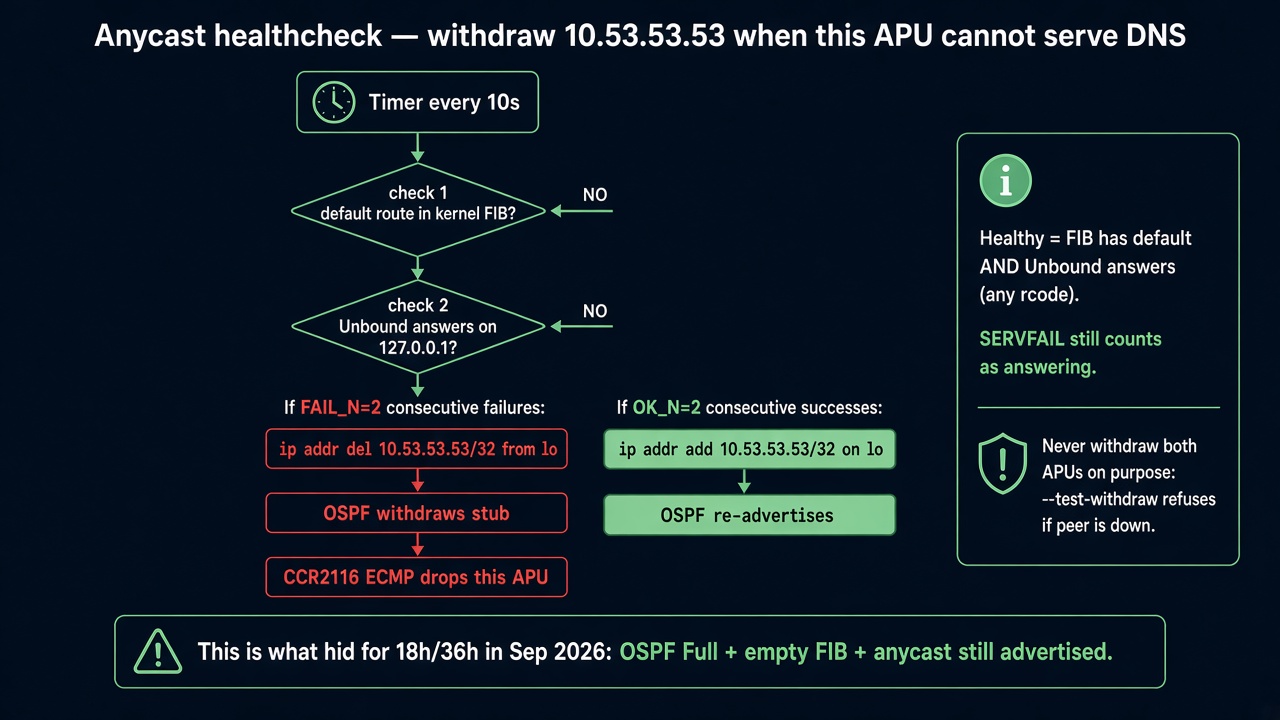
What healthy means
Healthy is both:
ip -4 route show default matches ^default). An empty FIB is what an OSPF-Full blackhole looks like from the box.
Unbound answers on 127.0.0.1 — dig +time=1 +tries=1 @127.0.0.1 example.com A prints a status: line. Any rcode counts, including SERVFAIL. The resolver is up; upstream may be down. That condition hits both APUs equally. Withdrawing both would turn a degraded cache into no DNS at all.
Hysteresis: FAIL_N=2 consecutive failures withdraw; OK_N=2 consecutive successes restore. The timer fires every 10 s (OnUnitActiveSec=10s), so a real fault takes ~20 s to leave the ECMP set, and a flap of a single check is held.
flowchart TD
  T["Timer every 10s"] --> F{"Default route in kernel FIB?"}
  F -->|no| FAIL
  F -->|yes| U{"Unbound answers on 127.0.0.1? any rcode"}
  U -->|no| FAIL
  U -->|yes| OK
  FAIL["FAIL_N=2 consecutive"] --> DEL["ip addr del 10.53.53.53/32 dev lo"]
  DEL --> W["OSPF withdraws the stub"]
  W --> ECMP["CCR2116 ECMP drops this APU"]
  OK["OK_N=2 consecutive"] --> ADD["ip addr add 10.53.53.53/32 dev lo"]
  ADD --> ADV["OSPF re-advertises"]
Why this exists — Sep 2026 blackholes
Trigger: a glibc upgrade made needrestart bounce systemd-networkd. networkd deleted FRR’s kernel nexthop objects; the kernel dropped every route that used them. FRR 8.4.4 never reinstalled them. Unbound kept answering locally. The adjacency stayed Full. The core kept both next hops in 10.53.53.53/32. Every client whose hash landed on the sick APU had no DNS, while pings, OSPF, and “unbound up” all looked fine.
Two other fixes sit beside the healthcheck (they do not replace it):
no zebra nexthop kernel enable on both APUs (classic nexthops; the #515 exposure was kernel NHG).
needrestart / networkd drop-ins so that bounce does not wipe the FIB.
The healthcheck is the last line: if the FIB is empty anyway, stop advertising the anycast.
Known interplay: netplan owns lo. A networkd reconfigure can put 10.53.53.53 back on an unhealthy APU; the next check (≤ 10 s) removes it again.
Safety rails
--test-withdraw first asks the peer (ANYCAST_PEER in /etc/default/anycast-healthcheck: apu01 → 192.168.53.2, apu02 → 192.168.53.3) for a NOERROR. If the peer is silent, the test refuses.
SERVFAIL / upstream loss is not a withdraw. Only “no default in FIB” or “Unbound does not answer at all”.
--test-withdraw writes a hold file so the timer cannot re-add the address mid-test. A hold older than 10 minutes is treated as leftover and removed.
The script never restarts FRR or Unbound. It only adds/deletes one /32 on lo.
anycast-healthcheck.sh                 # one check (what the timer runs)
anycast-healthcheck.sh --status        # print state, change nothing
anycast-healthcheck.sh --test-withdraw [secs]   # default 20s; refuses if peer is down
Live proof (install handover --apply --proof, measured 2026-09-15 12:45Z on apu02): core dropped to one next hop for 11 samples, 0 DNS misses, then both arms returned.
Where it lives
/usr/local/sbin/anycast-healthcheck.sh
Timer / unit
anycast-healthcheck.timer / .service
Peer env
/etc/default/anycast-healthcheck (ANYCAST_PEER=…)
State
/run/anycast-healthcheck.state
Workspace copy
mikrotik-workspace/scratch/anycast-hc/anycast-healthcheck.sh
Install handover
tools/handover/2026-09-13-apu-anycast-healthcheck.sh
The hp02 /apu page (REQ-DASH32) is the observer: timer state, --status, hold file, health-check journal, core ECMP set, and a per-APU verdict (healthy / withdrawn / degraded / blackhole / unreachable). It does not act. Withdrawal is the box’s decision; repair is the operator’s.