DNS APUs
Two PC Engines APU2 boxes (apu01 / apu02) run Unbound as a household anycast recursive resolver at **10.53.53.53**. FRR advertises that address over OSPF to the CCR2116 core, which ECMP-hashes clients onto whichever APUs are currently advertising. This book is the operator view: architecture, the anycast self-heal that closes the Sep 2026 OSPF-Full / empty-FIB blackholes, and the HOST-APU-01 listen map plus how the hp02 dashboard still scrapes metrics after Prometheus and node_exporter moved to localhost.
Architecture
DNS APUs — architecture
Two PC Engines APU2 boards in a 1U dual-slot 19" chassis are the household recursive DNS. Clients do not pick a box. DHCP (and the core intercept of rogue DNS) hands out 10.53.53.53. Each APU puts that address on lo and FRR advertises it as an OSPF stub. The CCR2116 core installs an ECMP pair and hashes each source/destination pair onto one arm.
This page is the map. The self-heal that withdraws a sick arm is Anycast self-heal. What still listens where, after HOST-APU-01, is Hardening and dashboard scrape. The rest of the household fabric (islands, VLANs, dual WAN, VRRP) is MikroTik fabric.
Rack photos
Hardware photos are the original 2019 gallery shots from racked the apu2s. The software on the boards has moved on (Unbound + FRR anycast, not Pi-hole/Traefik); the metal is the same.
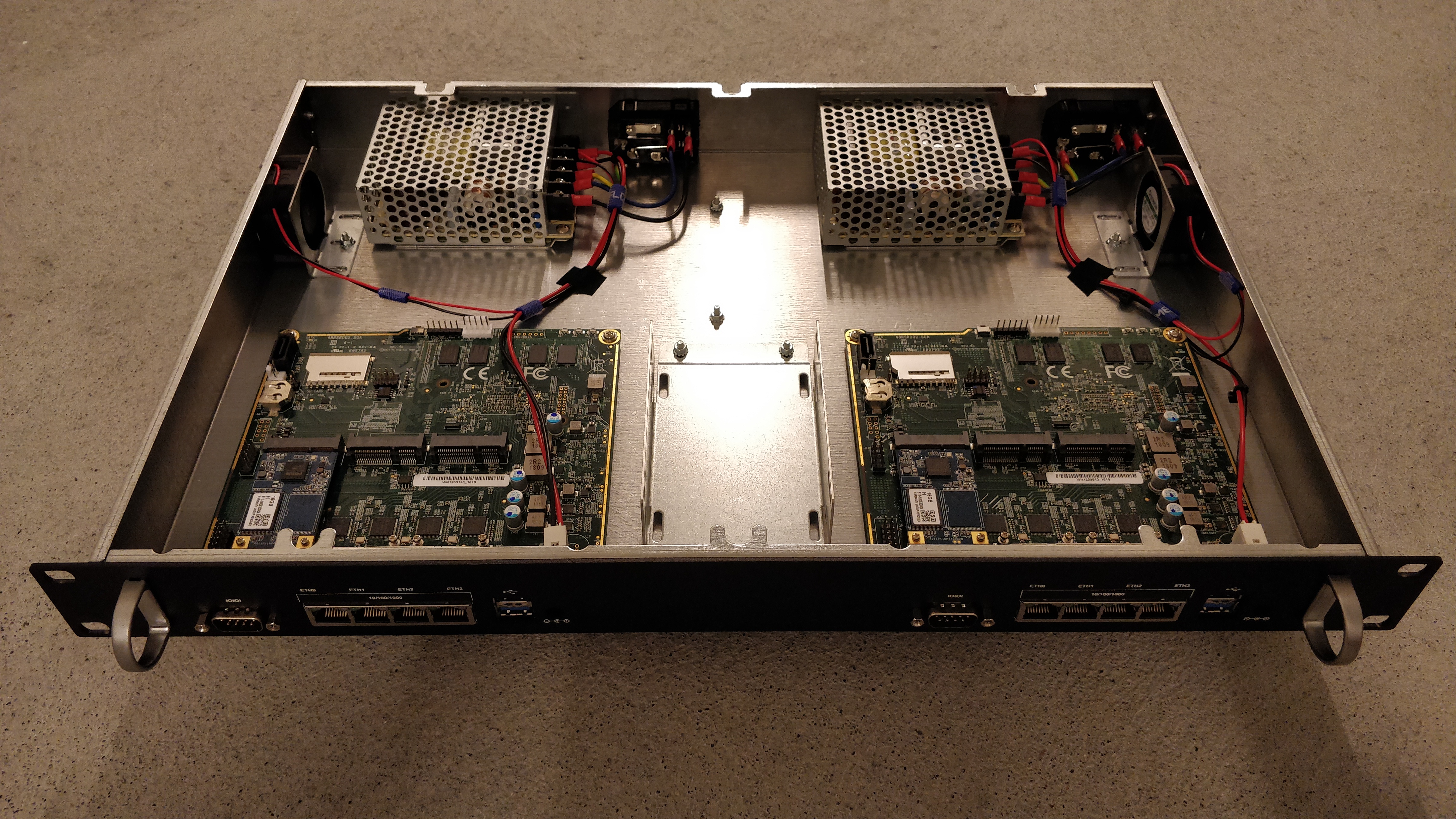
These are my apu2 DNServers running pihole on docker with traefik 2.0

Dual APU2 19" rack unit in the cabinet (yellow uplinks on ETH0)
Case parts
- the bare case (326744)
- the power supplies (326747)
- two fans (SUN-HA40201V4-1)
- two fan mounts (311857)
The boards were remounted from the standard APU case; the original aluminium heat spreader does not reuse — use APUCOOL. The 326744 kit includes the power socket that still needs to be soldered to the APU2; polarity matters.
Anycast architecture

Addressing
| Box | vlan89 (OOB) | vlan53 (OSPF / Unbound) | Other | Grafana |
|---|---|---|---|---|
| apu01 | 10.9.8.206 | 192.168.53.3 | wg0 172.16.75.1 (home WireGuard) |
http://10.9.8.206:3000/ |
| apu02 | 10.9.8.207 | 192.168.53.2 | — | http://10.9.8.207:3000/ |
| anycast | — | 10.53.53.53 on lo of each APU |
advertised via FRR OSPF | — |
| CCR2116 core | 10.9.8.252 | 192.168.53.1 | ECMP for 10.53.53.53/32 | — |
| hp02 dashboard | 10.9.8.253 | — | also 172.16.62.253; UI :8787 |
— |
OSPF/BFD peers on vlan53: CCR2116 192.168.53.1 ↔ apu01 192.168.53.3 and apu02 192.168.53.2. Both APUs run Ubuntu 24.04, Unbound (DNSSEC hardened), FRR, and BFD.
How a query lands
flowchart LR
C[Clients / DHCP stubs] -->|"UDP/TCP 53 → 10.53.53.53"| CORE[CCR2116 core]
CORE -->|"ECMP 10.53.53.53/32"| A1[apu01 Unbound]
CORE -->|"ECMP 10.53.53.53/32"| A2[apu02 Unbound]
A1 --- LO1["lo 10.53.53.53"]
A2 --- LO2["lo 10.53.53.53"]
CORE -->|"vlan53 OSPF + BFD"| A1
CORE -->|"vlan53 OSPF + BFD"| A2
RouterOS hashes ECMP per source/destination pair. One source address samples one arm. That is why /dns probes the anycast from more than one hp02 address (172.16.62.253 and 10.9.8.253) — a single probe cannot prove both APUs.
The core also intercepts rogue DNS (dst-nat of UDP/TCP 53 not already aimed at 10.53.53.53, from sources not on DNS-SERVERS) and sends it to the anycast. Production DHCP DNS is 10.53.53.53, not a vlan89 Grafana address.
What each box runs
- Unbound — recursive resolver, DNSSEC (
harden-glue,harden-dnssec-stripped). After HOST-APU-01 it is not bound to0.0.0.0; it listens on the fabric addresses (vlan89, vlan53, the anycast onlo, and on apu01 alsowg0). ACL is fabric prefixes, not all of RFC1918. - FRR OSPF — advertises
10.53.53.53/32as a stub oflo. Removing the address fromlowithdraws it from OSPF within about a second; putting it back re-advertises. Both boxes are hardened withno zebra nexthop kernel enableafter the Sep 2026 kernel-NHG blackholes. - Grafana :3000 — vlan89 only (10.9.8.206 / .207). Not on vlan53, not on
wg0. - Prometheus :9090, node_exporter :9100, unbound-exporter :9167 — 127.0.0.1 only. The hp02 dashboard scrapes them over SSH as
bodo@vlan89to127.0.0.1(see the hardening page). LAN:9090/:9100connection-refuses on purpose.
Operator surfaces
| Surface | URL | What it is |
|---|---|---|
| Grafana apu01 | http://10.9.8.206:3000/ | On-box dashboards, vlan89 only |
| Grafana apu02 | http://10.9.8.207:3000/ | Same |
| hp02 dashboard | :8787 on hp02 (/apu, /dns, /docker, /sites) |
Fleet view. Metrics over SSH after HOST-APU-01 |
/apu |
DASH-32 / REQ-DASH32 | Three angles: box (SSH), core (REST ECMP/OSPF), wire (UDP probes) |
/dns |
REQ-D5 | Unbound PromQL via SSH → 127.0.0.1:9090 |
/docker |
REQ-DF5 | APU pulse via SSH → 127.0.0.1:9100 (no Docker on the APUs) |
SSH to the APUs is as bodo, pubkey only, password auth off, root login off. Use vlan89 (10.9.8.206 / .207) — that path kept answering when vlan53 had no return route.
What this book is not
It is not a runbook to rewrite FRR, nftables, or Unbound on the live boxes. The applied shape lives in:
mikrotik-workspace/tools/handover/2026-09-15-apu-hardening.sh(HOST-APU-01)mikrotik-workspace/scratch/anycast-hc/anycast-healthcheck.shandtools/handover/anycast-hc/mikrotik-workspace/tools/handover/2026-09-13-apu-anycast-healthcheck.sh(install)- hp02
mikrotik-dashboard(apu.py,dns_collect.py,docker_fleet.py)
Anycast self-heal
Anycast self-heal
FRR on each APU advertises 10.53.53.53/32 as a stub of lo. The core therefore load-shares onto whatever is currently advertised, not “whatever has OSPF Full”. If an APU cannot actually serve DNS, it must take that address off lo itself. That is anycast-healthcheck.sh, run every 10 s by anycast-healthcheck.timer.
Without this, OSPF Full + an empty kernel FIB still looks like a live resolver. That is exactly the Sep 2026 blackholes.

What healthy means
Healthy is both:
- A default route exists in the main kernel FIB (
ip -4 route show defaultmatches^default). An empty FIB is what an OSPF-Full blackhole looks like from the box. - Unbound answers on 127.0.0.1 —
dig +time=1 +tries=1 @127.0.0.1 example.com Aprints astatus:line. Any rcode counts, including SERVFAIL. The resolver is up; upstream may be down. That condition hits both APUs equally. Withdrawing both would turn a degraded cache into no DNS at all.
Hysteresis: FAIL_N=2 consecutive failures withdraw; OK_N=2 consecutive successes restore. The timer fires every 10 s (OnUnitActiveSec=10s), so a real fault takes ~20 s to leave the ECMP set, and a flap of a single check is held.
flowchart TD
T["Timer every 10s"] --> F{"Default route in kernel FIB?"}
F -->|no| FAIL
F -->|yes| U{"Unbound answers on 127.0.0.1? any rcode"}
U -->|no| FAIL
U -->|yes| OK
FAIL["FAIL_N=2 consecutive"] --> DEL["ip addr del 10.53.53.53/32 dev lo"]
DEL --> W["OSPF withdraws the stub"]
W --> ECMP["CCR2116 ECMP drops this APU"]
OK["OK_N=2 consecutive"] --> ADD["ip addr add 10.53.53.53/32 dev lo"]
ADD --> ADV["OSPF re-advertises"]
Why this exists — Sep 2026 blackholes
| When | Box | Issue | What happened | How long |
|---|---|---|---|---|
| 2026-09-11 | apu02 | #497 | OSPF Full, kernel FIB empty, anycast still advertised | ~18 h |
| 2026-09-12 | apu01 | #523 / #515 | Same shape | ~36 h |
Trigger: a glibc upgrade made needrestart bounce systemd-networkd. networkd deleted FRR’s kernel nexthop objects; the kernel dropped every route that used them. FRR 8.4.4 never reinstalled them. Unbound kept answering locally. The adjacency stayed Full. The core kept both next hops in 10.53.53.53/32. Every client whose hash landed on the sick APU had no DNS, while pings, OSPF, and “unbound up” all looked fine.
Two other fixes sit beside the healthcheck (they do not replace it):
no zebra nexthop kernel enableon both APUs (classic nexthops; the #515 exposure was kernel NHG).- needrestart / networkd drop-ins so that bounce does not wipe the FIB.
The healthcheck is the last line: if the FIB is empty anyway, stop advertising the anycast.
Known interplay: netplan owns lo. A networkd reconfigure can put 10.53.53.53 back on an unhealthy APU; the next check (≤ 10 s) removes it again.
Safety rails
- Never withdraw both APUs on purpose.
--test-withdrawfirst asks the peer (ANYCAST_PEERin/etc/default/anycast-healthcheck: apu01 → 192.168.53.2, apu02 → 192.168.53.3) for a NOERROR. If the peer is silent, the test refuses. - SERVFAIL / upstream loss is not a withdraw. Only “no default in FIB” or “Unbound does not answer at all”.
--test-withdrawwrites a hold file so the timer cannot re-add the address mid-test. A hold older than 10 minutes is treated as leftover and removed.- The script never restarts FRR or Unbound. It only adds/deletes one
/32onlo.
anycast-healthcheck.sh # one check (what the timer runs)
anycast-healthcheck.sh --status # print state, change nothing
anycast-healthcheck.sh --test-withdraw [secs] # default 20s; refuses if peer is down
Live proof (install handover --apply --proof, measured 2026-09-15 12:45Z on apu02): core dropped to one next hop for 11 samples, 0 DNS misses, then both arms returned.
Where it lives
| Piece | Path |
|---|---|
| Script on the APU | /usr/local/sbin/anycast-healthcheck.sh |
| Timer / unit | anycast-healthcheck.timer / .service |
| Peer env | /etc/default/anycast-healthcheck (ANYCAST_PEER=…) |
| State | /run/anycast-healthcheck.state |
| Workspace copy | mikrotik-workspace/scratch/anycast-hc/anycast-healthcheck.sh |
| Install handover | tools/handover/2026-09-13-apu-anycast-healthcheck.sh |
The hp02 /apu page (REQ-DASH32) is the observer: timer state, --status, hold file, health-check journal, core ECMP set, and a per-APU verdict (healthy / withdrawn / degraded / blackhole / unreachable). It does not act. Withdrawal is the box’s decision; repair is the operator’s.
Hardening and dashboard scrape
Hardening and dashboard scrape
HOST-APU-01 (2026-09-15 fabric + APU review) closed the listen surface that the Sep 2026 anycast work did not touch. Grafana, Prometheus, node_exporter and unbound-exporter used to listen on every address. apu01 also terminates wg0 (172.16.75.1/24), so those sockets were reachable from every wg-home peer without crossing the core firewall.
After the bind change, LAN :9090 and :9100 connection-refuse. The hp02 dashboard still needs those numbers, so it scrapes over SSH as bodo to vlan89 and talks to 127.0.0.1 on the box. It never re-exposes those ports.

Listen map (after HOST-APU-01)
| Service | apu01 | apu02 |
|---|---|---|
Unbound DNS :53 |
vlan89 + vlan53 + wg0 + anycast on lo — not 0.0.0.0 |
vlan89 + vlan53 + anycast on lo — not 0.0.0.0 |
Grafana :3000 |
vlan89 only (10.9.8.206) | vlan89 only (10.9.8.207) |
Prometheus :9090 |
localhost | localhost |
node_exporter :9100 |
localhost | localhost |
unbound-exporter :9167 |
localhost | localhost |
SSH :22 |
vlan89 (bodo, pubkey) |
vlan89 (bodo, pubkey) |
Unbound ACL is fabric prefixes (10.9.8.0/24, 10.53.53.0/24, 192.168.32.0/19, 192.168.53.0/24, 172.16.62.0/24, 172.16.75.0/24), not all of RFC1918. Reload keeps an old 0.0.0.0:53 socket; a restart is what actually drops it.
On apu01 only, nftables table inet host_apu_01 is extra belt-and-braces: allow Grafana/metrics on lo and enp2s0 (vlan89), drop tcp/3000,9090,9100,9167 on every other ingress (wg0 and vlan53). Persist via include "/etc/nftables.d/host-apu-01.nft" in /etc/nftables.conf and nftables.service enabled. nft -f alone dies at reboot; enable without the include would load Debian’s flush-ruleset stub and wipe the live table.
Other HOST-APU-01 items: drop bodo from group lxd (membership is de-facto root); snap remove lxd if unused; apu02 sysctl drop-in (accept_redirects=0, send_redirects=0, rp_filter=2). Never run lxc / lxc list on these boxes — on Ubuntu 24.04 /usr/sbin/lxc is the lxd-installer stub and installs the snap.
Handover: mikrotik-workspace/tools/handover/2026-09-15-apu-hardening.sh (dry-run from hp02; --apply on the APU as root, with --dns / --nftables as needed).
How hp02 still sees the boxes
flowchart LR
subgraph hp02["hp02 dashboard :8787"]
DNS["/dns REQ-D5"]
DOCKER["/docker REQ-DF5"]
APU["/apu REQ-DASH32"]
SITES["/sites"]
end
DNS -->|"ssh bodo@10.9.8.206/.207"| P["127.0.0.1:9090 PromQL"]
DOCKER -->|"ssh bodo@vlan89"| N["127.0.0.1:9100 /metrics"]
APU -->|"one ssh round trip"| BOX["FIB, lo anycast, timer, Prom on localhost"]
SITES --> INV[inventory / live probes]
| Requirement | Page | What it scrapes | What it must not do |
|---|---|---|---|
| REQ-D5 | /dns |
One SSH per APU to vlan89; remote helper queries http://127.0.0.1:9090 for the existing PromQL (Unbound + node). Grafana links stay on vlan89. |
Must not scrape a LAN :9090 URL. That path refuses, and /dns used to paint PROM DOWN while Unbound was answering 9/9. |
| REQ-DF5 | /docker |
One SSH, curl http://127.0.0.1:9100/metrics on the box. APUs are kind: node_exporter (system pulse only — no Docker). A leftover LAN node_url is ignored when ssh is set. |
Must not scrape vlan89/vlan53 :9100. That painted apu01/apu02 red (Connection refused) while the boxes were up. |
| REQ-DASH32 | /apu |
Same SSH path: default route, OSPF route count, nexthop mode, 10.53.53.53/32 on lo, healthcheck --status / timer / journal, a smaller Unbound Prom set. Plus core REST (ECMP + OSPF/BFD) and UDP probes. |
Does not act; does not read root-only frr.conf / nft. |
SSH details that matter for the poller: user bodo, no sudo, ssh -n / stdin closed so apu01 Defaults use_pty cannot hang the dashboard. Fail-soft: SSH failure is prometheus unreachable / status: error, never an exception — probes still run.
Dashboard pages to open
| Path | Role |
|---|---|
/apu |
Anycast arms, self-heal, blackhole vs withdrawn vs healthy |
/dns |
Unbound QPS, cache, rcodes — Prom over SSH |
/docker |
APU load/mem from node_exporter over SSH (and Docker hosts elsewhere) |
/sites |
Site / inventory view of the same two boxes |
Grafana remains the on-box UI: http://10.9.8.206:3000/ and http://10.9.8.207:3000/. Prometheus and the exporters have no LAN URL after HOST-APU-01; do not add one back so the dashboard can “just HTTP”.